<?xml version="1.0" encoding="utf-8"?>
<feed xmlns="http://www.w3.org/2005/Atom"
	xml:lang="en">
	<title>Spacezone is not a blog / en</title>
	<subtitle>Confused on a higher level</subtitle>
        <link rel="alternate" type="text/html" href="http://www.spacezone.de/blog/en/"/>
        <link rel="self" type="application/atom+xml" href="http://www.spacezone.de/blog/en/atom.xml"/>
	<updated>2010-02-19T21:50:12+01:00</updated>
	<author>
	<name>Jan</name>
	<uri>http://www.spacezone.de/blog/en/</uri>
	<email></email>
	</author>
	<id>tag:spacezoneisnotablog,2010:Spacezoneisnotablogen</id>
	<generator uri="http://www.pivotlog.net" version="Pivot - 1.40.7: 'Dreadwind'">Pivot</generator>
	<rights>Copyright (c) 2010, Authors of Spacezone is not a blog / en</rights>


	<entry>
		<title>Microsoft, please keep using highly compressed JPEGs to illustrate your products</title>
		<link rel="alternate" type="text/html" href="http://www.spacezone.de/blog/pivot/entry.php?id=112&amp;w=en" />
		<updated>2010-02-19T21:50:00+01:00</updated>
		<published>2010-02-19T21:43:00+01:00</published>
		<id>tag:spacezoneisnotablog,2010:Spacezoneisnotablogen.112</id>
		<link rel="related" type="text/html" href=""  />
		<summary type="text"></summary>
        <content type="html" xml:lang="en" xml:base="http://www.spacezone.de/blog/pivot/entry.php?id=112&amp;w=en"><![CDATA[
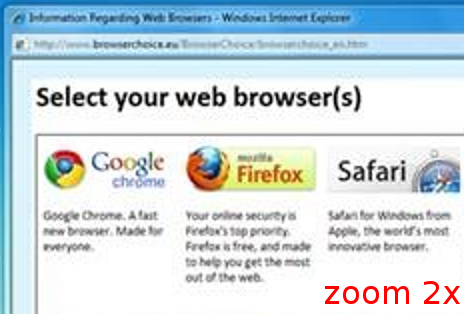
                <p><img src="http://spacezone.de/blog/images/ie8_h80px.png" style="border:0px solid" title="IE logo with JPEG artefacts" alt="IE logo with JPEG artefacts" class="pivot-image" /></p><p>Microsoft has <a href="http://microsoftontheissues.com/cs/blogs/mscorp/archive/2010/02/19/the-browser-choice-screen-for-europe-what-to-expect-when-to-expect-it.aspx" title="The Browser Choice Screen for Europe: What to Expect, When to Expect It">enlightened</a> the European public on the upcomming Browser Choice Screen including screen shots. JPEGs. Highly compressed:</p>
<p style="text-align:center;"><img src="http://spacezone.de/blog/images/ms_browser_choice.png" style="border:0px solid" title="Zoom of Microsoft's browser ballot screen" alt="Zoom of Microsoft's browser ballot screen" class="pivot-image" /></p>
<p><i>Source: <a href="http://microsoftontheissues.com/cs/blogs/mscorp/archive/2010/02/19/the-browser-choice-screen-for-europe-what-to-expect-when-to-expect-it.aspx" title="The Browser Choice Screen for Europe: What to Expect, When to Expect It">article</a>, <a href="http://microsoftontheissues.com/cs/blogs/mscorp/clip_image002_136F9F12.jpg">image</a></i></p>
<p>Right so, Microsoft, no one was going to read the text anyway. And those pixels and compression artefacts only prove that the image originates on a computer.</p>
<p>Nice to see when JPEG quality matches the product quality.</p>
		]]></content>
		<author>
			<name>jan</name>
		</author>
	</entry>


	<entry>
		<title>Panoptoclick, Panoptiklick, ...</title>
		<link rel="alternate" type="text/html" href="http://www.spacezone.de/blog/pivot/entry.php?id=111&amp;w=en" />
		<updated>2010-02-01T01:32:00+01:00</updated>
		<published>2010-02-01T01:31:00+01:00</published>
		<id>tag:spacezoneisnotablog,2010:Spacezoneisnotablogen.111</id>
		<link rel="related" type="text/html" href=""  />
		<summary type="text"></summary>
        <content type="html" xml:lang="en" xml:base="http://www.spacezone.de/blog/pivot/entry.php?id=111&amp;w=en"><![CDATA[
                <p>The <a href="http://www.eff.org" title="EFF">Electronic Frontier Foundation</a> has setup a nice tool called <a href="https://panopticlick.eff.org/">Panopticlick</a>. It demonstrates that web browsers have (almost) unique fingerprints. This was covered by <a href="http://www.wired.co.uk/news/archive/2010-01/29/your-digital-fingerprint-makes-you-easy-to-track.aspx" title="Why your digital fingerprint makes you easy to track">wired</a>, appeared on <a href="http://www.reddit.com/r/browsers/comments/auy1z/help_eff_research_web_browser_tracking_with/?sort=hot" title="Help EFF Research Web Browser Tracking with Panopticlick">reddit</a> and <a href="http://twitter.com/search?q=%23Panopticlick" title="#Panopticlick">Twitter</a>.<p>German readers found Panopticlick mentioned in
<a href="http://www.zeit.de/digital/datenschutz/2010-01/browser-fingerabdruck-eff">ZEIT Online</a>, <a href="http://futurezone.orf.at/stories/1637826/">ORF futurezone</a>, and, of course,
<a href="http://www.heise.de/newsticker/meldung/EFF-demonstriert-den-Fingerabdruck-des-Browsers-918262.html">heise news</a>. (By the way, I've seen it on 
<a href="http://blog.kairaven.de/archives/1818-Panopticlick-Experimente-gegen-Web-Tracking.html">ravenhorst</a> first. Subscribe to <a href="http://blog.kairaven.de">Kai's blog</a> if you want more like this.)
</p>
<p>However, it seems nobody can remember the name. So I thought I'd help. It's <strong><a href="https://panopticlick.eff.org/">Panopticlick</a></strong>!</p>
		]]></content>
		<author>
			<name>jan</name>
		</author>
	</entry>


	<entry>
		<title>ASP.NET not found on localhost</title>
		<link rel="alternate" type="text/html" href="http://www.spacezone.de/blog/pivot/entry.php?id=104&amp;w=en" />
		<updated>2009-07-21T23:31:00+01:00</updated>
		<published>2009-07-21T23:31:00+01:00</published>
		<id>tag:spacezoneisnotablog,2010:Spacezoneisnotablogen.104</id>
		<link rel="related" type="text/html" href=""  />
		<summary type="text"></summary>
        <content type="html" xml:lang="en" xml:base="http://www.spacezone.de/blog/pivot/entry.php?id=104&amp;w=en"><![CDATA[
                <pre>$ lynx --dump --head http://www.some-university.de/default.aspx?something.html
HTTP/1.1 302 Found
Connection: close
Content-Length: 1520
Date: Tue, 21 Jul 2009 12:42:50 GMT
Location: <b>http://localhost/</b>
Content-Type: text/html; charset=utf-8
Server: <b>Microsoft-IIS/7.0</b>
X-Powered-By: <b>ASP.NET</b></pre>
<p>I'm sure it worked when <i>they</i> tested it.</p>
<p>And it's purely coincidental that broken websites have ".aspx" in their URIs.</p>
		]]></content>
		<author>
			<name>jan</name>
		</author>
	</entry>


	<entry>
		<title>Internet Censorship World Tour: Now playing in Germany!</title>
		<link rel="alternate" type="text/html" href="http://www.spacezone.de/blog/pivot/entry.php?id=95&amp;w=en" />
		<updated>2009-05-23T19:02:00+01:00</updated>
		<published>2009-05-21T04:36:00+01:00</published>
		<id>tag:spacezoneisnotablog,2010:Spacezoneisnotablogen.95</id>
		<link rel="related" type="text/html" href=""  />
		<summary type="text"></summary>
        <content type="html" xml:lang="en" xml:base="http://www.spacezone.de/blog/pivot/entry.php?id=95&amp;w=en"><![CDATA[
                <img src="http://spacezone.de/blog/images/zensurstop_h80px.png" style="border:0px solid" title="Stop Censorship Banner" alt="Stop Censorship Banner" class="pivot-image" /><a href="http://spacezone.de/blog/images/leaders.png"><img src="http://spacezone.de/blog/images/leaders_w360px.png" style="border:0px solid" title="World leaders for Civilized Interwebs" alt="World leaders for Civilized Interwebs" class="pivot-image" /></a>
<p>
<b>Background:</b>
The <b>German</b> government is pushing to establish internet filters. In a first step, <a href="http://en.wikipedia.org/wiki/Federal_Ministry_for_Family_Affairs,_Senior_Citizens,_Women_and_Youth">Federal Minister</a> Ursula von der Leyen nicknamed Zensursula pressured most major internet service providers to <a href="http://www.kruedewagen.de/blog/2009/04/17/geheimer-vertrag-zu-geheimen-web-sperren-unterzeichnet/">sign a secret contract</a> with the <a href="http://en.wikipedia.org/wiki/Federal_Criminal_Police_Office">BKA</a> about implementing an unspecified technology (probably DNS manipulation) to block access to web sites on a confidential list.
The federal parliament is <a href="http://www.zeit.de/online/2009/20/netzsperren-spd">debating</a> a <a href="http://blog.beck.de/2009/04/22/gesetzentwurf-zu-internetsperren-im-kabinett-beschlossen">bill on internet blacklists</a>.
</p><p>
Zensursula advocates the use of secret blacklist to "make it more difficult" for child abusers to commercially trade video documents of their deeds. However, even members of government have <a href="http://www.abendblatt.de/politik/deutschland/article992506/Gesetz-gegen-Kinderpornografie-im-Internet.html">expressed</a> their concerns that the technology will be used to block other content. Other politicians are already coming up with wishlists <a href="http://www.heise.de/newsticker/Medienrechtsforum-Forderungen-nach-Ausweitung-von-Internetsperren--/meldung/136764">to block access to online casinos and unlicensed use of copyrighted material</a>.
</p><p>
A <a href="http://netzpolitik.org/2009/buendnis-fordert-schaerferes-zensursula-gesetz/">coalition of lobby groups</a> lead by the "association of video and media retailers in Germany" and other <a href="http://www.carechild.de/news/politik/internetzensur_getuerkte_umfrage_der_deutsche_kinderhilfe_e.v._widerlegt_582_120.html">questionable NGOs</a> raise their voices for further access blocking. Proponents of internet filtering spread the message through mainstream media that people opposing censorship are either <a href="http://www.golem.de/0904/66730.html">criminal child abusers</a> or <a href="http://www.stern.de/computer-technik/internet/:Unterschriftensammlung-Die-Kinderhilfe-Internetsperren/701102.html">a "minority" of internet "lovers"</a>.
</p><p>
A <a href="http://mitzeichner.appspot.com/">petition against internet filters</a> has been signed by 88000 voters so far. Pro-filtering politicians (that is the majority of government and parliament) have ignored or <a href="http://www.abgeordnetenwatch.de/dr_dieter_wiefelspuetz-650-5785--f180717.html#q180717">ridiculed</a> the petition. The same parliament under the same government has passed a statue <a href="http://cb064.wordpress.com/2009/04/28/bundestags-drucksache-168871/">against internet censorship</a>, especially in <b>China</b>, just one year ago. And on <b>Australia</b>'s <a href="http://www.tgdaily.com/content/view/41815/108/">leaked blacklist</a> there is the website of a dentist.
</p><p>
The <b>image</b> above was made with <a href="http://www.gimp.org">the GIMP</a> (<a href="http://spacezone.de/blog/images/leaders.xcf">original file</a>) and is licensed <a rel="license" href="http://creativecommons.org/licenses/by-sa/3.0/">CC-BY-SA</a>. Photographs of <a href="http://commons.wikimedia.org/wiki/File:Hu_Jintao_2004.jpg">Hu Jintao</a>, <a href="http://commons.wikimedia.org/wiki/File:KevinRuddZoom.JPG">Kevin Rudd</a>, and <a href="http://commons.wikimedia.org/wiki/File:Angela_Merkel_24092007.jpg">Angela Merkel</a> have been retrieved from Wikimedia Commons with compatible licenses.</p>
		]]></content>
		<author>
			<name>jan</name>
		</author>
	</entry>


	<entry>
		<title>Excuse #1001 for failing college: My computer didn't work and it's all Ubuntu's fault!</title>
		<link rel="alternate" type="text/html" href="http://www.spacezone.de/blog/pivot/entry.php?id=87&amp;w=en" />
		<updated>2009-01-17T21:08:00+01:00</updated>
		<published>2009-01-15T23:31:00+01:00</published>
		<id>tag:spacezoneisnotablog,2010:Spacezoneisnotablogen.87</id>
		<link rel="related" type="text/html" href=""  />
		<summary type="text">This is the story of a girl, who looks so dumb on the internet.</summary>
        <content type="html" xml:lang="en" xml:base="http://www.spacezone.de/blog/pivot/entry.php?id=87&amp;w=en"><![CDATA[
                <p><i>This is the <a href="http://de.youtube.com/watch?v=WWF_DZx-qS0" title="Nine Day: Absolutely (Story Of A Girl)">story of a girl</a>, who looks so dumb on the internet.</i></p><p>
<a href="http://www.wkowtv.com/Global/story.asp?S=9667184">WKOW TV</a> has the unbelievable story of Abbie who failed to get a college education from <a href="http://matcmadison.edu/matc/">Madison Area Technical College</a>. To attend online courses she bought a Dell computer. Unbelievable? Well, they claim, she bought an Ubuntu machine &ndash; by accident. <i>That's Unbelievable!</i>
</p>
<p>
If you think there's a grain of truth to this story, you never visited <a href="http://www.dell.com/content/default.aspx?c=us&amp;l=en&amp;s=gen&amp;~ck=cr" title="Dell USA">Dell's website</a>. Go there now! The first thing you will notice is the confusion about all those fake options: Home vs. Office, Latitude vs. Vostro. However, all these computers in all those categories are Windows computers (except for the <a href="http://www.dell.com/content/topics/segtopic.aspx/laptop-mini?c=us&amp;cs=19&amp;l=en&amp;ref=lthp&amp;s=dhs" title="Dell Mini">Mini</a> <a href="http://www.spacezone.de/blog/pivot/entry.php?id=81&amp;w=en" title="(Netbook) vendors push Linux and still don't get it">netbook</a>, which is available with Ubuntu or Windows XP). If you really want Ubuntu from Dell you have to navigate to <a href="http://dell.com/ubuntu">dell.com/ubuntu</a>, where you will find a huge warning that Ubuntu is not Windows. And if you're unsure, they will always recommend Windows.
</p>
<p>
So, it's obvious now that she knew she was buying an Ubuntu PC, which differs from the "bread and butter" Windows thing. Probably someone recommended it to her.
</p>
<p>
The article further claims the poor girl failed two semesters (and dropped out of college) <b>because of Ubuntu</b>. So Abbie spend a full year doing exactly nothing because Dell sold her a computer that didn't work for her. She failed and now she's blaming it on an operating system. <i>I sens quality journalism here.</i>
</p>
<p>
Listen, Abbie, a technical issue (a Windows virus, some proprietary bullshit that doesn't work with Linux, or the bad karma you get for buying an overpriced Mac) can keep you busy for a week, not a year. We have been through this before, it's a pretty lame excuse. Even if they throw a <a href="http://en.wikipedia.org/wiki/Slide_rule" title="Wikipedia: Slide Rule">Slide Rule</a> at you &ndash; they work on a logarithmic system, which won't run Microsoft Word,&ndash; you should be able to figure things out in less than a week.
</p>
<p>
By the way, did everyone notice:
</p>
<ul><li>Both WKOW and Dell have ".asp" in their URIs, proudly showing their love for a Software Giant from Redmond.</li>
<li>No one from the Ubuntu community offered to help Abbie with her Linux problems. Maybe even Geeks can learn not to feed the media troll.</li></ul>
<p>Poor Abbie, you probably want to talk to this WKOWTV station, they made you look bad on the internet.</p>
<p><b>Update:</b>
WOKW has posted <a href="http://www.wkowtv.com/Global/story.asp?S=9682258&amp;nav=menu1362_2" title="1st Follow Up">two</a>
<a href="http://addins.wkowtv.com/blogs/troubleshooter/?p=24" title="Final Follow Up">follow-ups</a> to this story.</p>
		]]></content>
		<author>
			<name>jan</name>
		</author>
	</entry>


	<entry>
		<title>Ubuntu is not ready for human beings</title>
		<link rel="alternate" type="text/html" href="http://www.spacezone.de/blog/pivot/entry.php?id=82&amp;w=en" />
		<updated>2008-11-16T22:19:00+01:00</updated>
		<published>2008-11-16T21:01:00+01:00</published>
		<id>tag:spacezoneisnotablog,2010:Spacezoneisnotablogen.82</id>
		<link rel="related" type="text/html" href=""  />
		<summary type="text"></summary>
        <content type="html" xml:lang="en" xml:base="http://www.spacezone.de/blog/pivot/entry.php?id=82&amp;w=en"><![CDATA[
                <p>
I'm a human being and I like Linux including the command line stuff. I use Debian, Ubuntu and OpenSuse on daily basis. I would like to recommend Linux to other human beings. Ubuntu is the most popular choice. However from Edgy Eft to Intrepid Ibex Ubuntu has regularly disappointed me. (The long time support release 8.04 Hardy Heron works best by my experience.)
</p>
<blockquote>
<p>
<b>1. Updating</b> Ubuntu to a new release is simple, but each time it will break something. This may be true for other operating systems, too, but Ubuntu releases 16 times more often then Microsoft does. No human being wants his most important device broken twice a year.
</p><p>
<b>2. </b>If you don't <b>test it</b>, it doesn't work, right? I can make a long list of packages in each Ubuntu release (all repositories because I don't know or care which packages are in "universe" or somewhere else) which have never been tested by the maintainer. I can usually fix it by editing a conf file, setting file permissions, etc, but it doesn't make a good impression if the <i>default configuration</i> doesn't work.
</p>
</blockquote>
<p>
The points above can be blamed on <a href="https://wiki.ubuntu.com/IntrepidReleaseSchedule" title="Intrepid Release Schedule">Ubuntu's release schedule</a> which allows only two month from "feature freeze" to the final release. The whole process is time based. Debian on the other hand follows a sophisticated <a href="http://en.wikipedia.org/wiki/Debian#Package_life_cycle">release cycle</a>: New packages are uploaded to "unstable", developers and beta testers can choose to install them, but normal users wouldn't. Only if a package meets certain <i>quality standards</i> it can be moved to "testing", which is actually a pretty usable distribution comparable with Ubuntu, power users tend to run "testing" on their computers. However changes occur frequently and they may require some configuration or you may run into compatibility issues with applications not part of Debian. Conservative users (like me) avoid "testing" most of the time and run "stable". "Testing" becomes "stable" <i>when it's ready</i>, that is when developers, beta testers and release managers believe there are no more bugs. A "stable" Debian system doesn't change unless the user explicitly install newer applications. However all security issues are automagically fixed without breaking anything.
</p>
<blockquote>
<p>
<b>3. Configuration</b> or lack thereof. Windows has the control panel, Debian comes with scripts asking for configuration options built into the package management, Suse uses Yast and LFS uses text files and shell scripts. All of them suck, but <i>Ubuntu has no configuration tool</i> at all. Some things can be fine tuned from within Gnome or KDE and no one ever stopped me from editing configuration files, <i>but what is the average human being supposed to do when X doesn't start?</i> No matter how well Ubuntu runs on your computer, there's always something that doesn't work for me.
</p><p>
<b>4. Documentation and help</b>, which is acutally helpful when things don't work. When command line programs fail there's usually some text output on there screen. Even if it looks Japanese to you, you can still google it. Ubuntu and most graphical applications always fail in one of two ways: Either everything looks normal (but doesn't do what the user wants to do) or it looks strange (and doesn't work). Many Human-Being-tries-Linux-problems involve the human being not being able to find the application or documentation he needs. Can't we have hints built into the UI like "If your graphics card(s) and monitor(s) have been correctly detected or configured, you can set up screen resolution and secondary screens here. Otherwise use the X11 configuration tool"
</p><p>
<b>5. Efficiency</b>:
The most popular use of Linux is turning old or underpowered computers into powerful workstations and Linux can do this, but Ubuntu (including Xubuntu) doesn't exactly shine on slow hardware. It just takes too long to boot. <a href="http://wubi-installer.org/">Wubi</a>, the Windows Ubuntu Installer, requires 5GB of HDD space. This doesn't look very lightweight to new Ubuntu users. 
</p>
</blockquote>
<p>
I like the idea of Desktop Linux and I like Ubuntu for making the idea popular. And I know very well that what people expect of Linux is often contradictory. However, we can do better; certainly a lot better than Intrepid Ibex, the current version of Ubuntu.
</p>
<p>
PS: <i>To all human beings frustrated because Ubuntu didn't work when they first tried it:</i> Keep trying. Try a different distribution. Try <a href="http://www.debian.org/">Debian stable</a> when you like Linux and don't mind using the command line and searching the web for help. Try <a href="http://www.opensuse.de">OpenSuse</a> if you want a configuration utility. Or try a "live" distribution which boots from CD, DVD or USB storage device. <i>And If you like Ubuntu or any other Linux variant, use it, improve it and spread the word.</i></p>
		]]></content>
		<author>
			<name>jan</name>
		</author>
	</entry>


	<entry>
		<title>(Netbook) vendors push Linux and still don't get it</title>
		<link rel="alternate" type="text/html" href="http://www.spacezone.de/blog/pivot/entry.php?id=81&amp;w=en" />
		<updated>2008-11-16T22:16:00+01:00</updated>
		<published>2008-10-22T23:44:00+01:00</published>
		<id>tag:spacezoneisnotablog,2010:Spacezoneisnotablogen.81</id>
		<link rel="related" type="text/html" href=""  />
		<summary type="text"></summary>
        <content type="html" xml:lang="en" xml:base="http://www.spacezone.de/blog/pivot/entry.php?id=81&amp;w=en"><![CDATA[
                <p>
Asus, Dell, Acer, MSI and others have finally arrived in the consumer market for Linux computers. Each offer a product called <a href="http://en.wikipedia.org/wiki/Netbook" title="Wikipedia: Netbook">netbook</a> in Linux and Windows XP variants. How are they  dealing with this unfamiliar choice?
</p><p>
The Ubuntu powered <a href="http://www1.euro.dell.com/content/products/productdetails.aspx/laptop-inspiron-9?c=uk&amp;l=en&amp;s=dhs&amp;cs=ukdhs1" title="Dell UK: Inspiron Mini 9">Dell Mini</a> comes with less powerful hardware and sells at a slightly lower price than its Windows cousins. Other vendors' pricing is similar. <i>So, if you want it cheap you have to deal with Linux.</i> Is this the message? Dell's website <a href="http://www1.euro.dell.com/content/learnmore/learnmore.aspx/hmc_os_mini9?c=uk&amp;l=en&amp;s=dhs&amp;~lt=popup" title="Help Me Choose: OS">explains</a> that Windows offers a familiar GUI and "Best of Web". Linux on the other hand has &ndash; according to Dell &ndash; a customized GUI and OpenOffice. <i>Is this going to help anyone?</i>
</p><p>
<a href="http://www.liliputing.com/2008/10/msi-canonical-linux-based-netbooks-returned-more-often.html" title="liliputing.com article">MSI</a> surprised us recently with the "fact" that Linux netbooks were more likely to be returned than peanut butter sandwiches. People quickly concluded that Linux was less tasty or harder to eat than peanut butter, but the data doesn't support this. We only know that the Linux netbook didn't match what some customers expected. <i>Should they have researched better?</i> The official <a href="http://global.msi.com.tw/index.php?func=prodpage2&amp;maincat_no=135&amp;cat2_no=582">MSI Wind homepage</a> doesn't even mention Linux. <i>How are buyers supposed to know what they are getting if you don't even try to tell them?</i>
</p><p>
<a href="http://www.silicon.de/cio/strategie/0,39038989,39196978,00/interview+linux_netbooks+verkaufen+sich+schlecht.htm" title="German Interview with Acer">Acer's Stefan Engel</a> complained shop owners and buyers wouldn't understand the netbook products confusing them with notebooks. By Acer's definition a netbook is <i>not quite a notebook</i> and Linux is good enough for netbooks because you don't want to use them for anything serious anyway. <a href="http://blog.laptopmag.com/asus-ceo-reveals-eee-pc-sales-numbers-plans-for-touch-eee-pcs-and-more-eee-family-products" title="Laptop Mag story">Asus recently stated</a> that a portable computer with a 10 inch screen is clearly a netbook while from 11 inch upwards we are in the notebook regime. <i>Size matters.</i>
</p><p>
Later in the same interview the Acer spokesman tells us consumers want webcams, but don't need battery life. It's this kind of bullshit that makes me more angry then their failure to provide better Linux computers. Cameras are dirt cheap and they make a good feature for marketing. Batteries (and energy efficient design) are expensive and harder to sell. That's why we get cameras no matter how useless.
</p><p>
It's a long way to the perfect Linux computer and it's good to know major vendors are on their way. I know, neither Acer nor anyone else will listen to my advice, but can you please memorize this:
</p>
<ul><li>A netbook is a computer.</li>
<li>When we ask for a computer of any size (<a href="http://www.comsciences.com/product.htm" title="iKit">2.8"</a>, <a href="http://en.wikipedia.org/wiki/Nokia_N810" title="N810">4.1"</a>, ..., <a href="http://www.pcstats.com/articleview.cfm?articleid=1443&amp;page=3" tilte="Large LCD Monitor">40"</a>) we want a computer &ndash; not a have-fun-browsing-the-web appliance nor a kill-your-time-while-pretending-to-work device. And we want the computer to work the way we like it. With Linux.</li>
<li><a href="http://en.wikipedia.org/wiki/There%27s_a_sucker_born_every_minute" title="Wikipedia">There's a sucker born every minute,</a> but don't tell us directly. It hurts.</li>
</ul>
		]]></content>
		<author>
			<name>jan</name>
		</author>
	</entry>


	<entry>
		<title>﻿Secure online storage for Linux</title>
		<link rel="alternate" type="text/html" href="http://www.spacezone.de/blog/pivot/entry.php?id=79&amp;w=en" />
		<updated>2008-09-23T01:04:00+01:00</updated>
		<published>2008-09-21T17:09:00+01:00</published>
		<id>tag:spacezoneisnotablog,2010:Spacezoneisnotablogen.79</id>
		<link rel="related" type="text/html" href=""  />
		<summary type="text">Once in your lifetime you will loose important data from hard drive failures, theft or stupidity. You will need disaster safe backups ...</summary>
        <content type="html" xml:lang="en" xml:base="http://www.spacezone.de/blog/pivot/entry.php?id=79&amp;w=en"><![CDATA[
                <p>Once in your lifetime you will loose important data from hard drive failures, theft or stupidity. You will need disaster safe backups ...</p><ul><li>
Off-site
</li><li>
Encrypted. (Encrypting the data transfer (as in HTTPS) or encrypting on the server is not sufficient.)
</li><li>
Selective (Simple access to the important stuff)
</li><li>
Efficient (Incremental)
</li><li>
Affordable (for a life time)
</li><li>
Reliable (on a long time scale)
</li><li>
Automated (In practise no one burns DVDs and brings them to a friend's house on a regular basis.)
</li></ul>

<p>Any decent server could do the job, but maintaining a dedicated server is too expensive in terms of time, energy and bandwidth for personal use. So I'm looking for a suitable service.
</p>
<table><tr><th>* rsync.net:</th>
<td>USD 19.20</td><td>= <a href="http://www.google.com/search?q=19.2+usd+in+eur">EUR 13.27</a><td>per GB and year</td>
</tr></table>
<p>
From a technological standpoint <a href="http://www.rsync.net/">rsync.net</a> rules anything I could find: A full featured filesystem accessible through standard UNIX protocols (ssh!). Use with <a href="http://sourceforge.net/projects/rsyncrypto">rsyncrypto</a> or <a href="http://duplicity.nongnu.org/">duplicity</a>.
</p>
<table><tr><th>* Amazon S3:</th>
<td>USD 1.80</td><td>= <a href="http://www.google.com/search?q=1.80+usd+in+eur">EUR 1.24</a></td><td>per GB (storage) and year</td></tr>
<tr><td>+</td>
<td>USD 0.27</td><td>= <a href="http://www.google.com/search?q=0.27+usd+in+eur">EUR 0.19</a></td><td>per GB up and download</td></tr>
<tr><td>+</td>
<td>USD 0.11</td><td>= <a href="http://www.google.com/search?q=0.11+usd+in+eur">EUR 0.08</a></td><td>per 10000 PUT and GET requests</td></tr>
<tr><td>=</td>
<td>USD 2.18</td><td>= <a href="http://www.google.com/search?q=2.18+usd+in+eur">EUR 1.51</a></td><td>(estimated) per year to backup 1 GB</td></tr>
</tr></table>
<p>
<a href="http://www.amazon.com/gp/browse.html?node=16427261">Amazon's Simple Storage service</a> is the cheapest storage service I'm aware of. They provide a simple database and web API, which can be used like a filesystem when using some client software that does the trick (key = path and filename, object = binary data). A commercial client (command line and GUI) with built-in encryption and automated backups is <a href="http://www.jungledisk.com/">JungleDisk</a> (Linux, Windows, Mac; USD 20.00 = <a href="http://www.google.com/search?q=20+usd+in+eur">EUR 13.83</a>). There are quite a <a href="http://developer.amazonwebservices.com/connect/kbcategory.jspa?categoryID=47" title="Amazon Community Code">number</a> of <a href="http://jeremy.zawodny.com/blog/archives/007641.html" title="List of S3 backup tools">open</a> source tools, I tend to like <a href="http://s3tools.logix.cz/s3tools">s3tools (s3cmd, s3sync, ...)</a> (Ruby, all platforms) most. Note that different S3 applications may use incompatible storage schemes.
</p>
<table><tr><th>* getdropbox.com:</th>
<td>free</td><td>2GB</td></tr>
</table>
<p>
<a href="http://www.getdropbox.com/">Dropbox</a> provides a closed source daemon, which will communicate with their server through a proprietary protocol to sync a local directory. Requires a recent version of Gnome. An AJAX web interface (for browsers) is available, too. For encrypted backups, you will rely on locally running <a href="http://sourceforge.net/projects/rsyncrypto">rsyncrypto</a> or similar.
</p>
<table><tr><th>* box.net:</th>
<td>free</td><td></td><td>1GB</td>
</tr>
<tr><td></td><td>USD 65.88</td><td>= <a href="http://www.google.com/search?q=65.88+usd+in+eur">EUR 45.56</a></td><td>for 5GB per year</td>
</tr></table>
<p>
<a href="http://box.net/">Box.net</a>'s main access method is a through a web browser. They also provide a web API, which can be used by <a href="http://enabled.box.net/projects/3/tags-/page-1" title="Box.net clients for Linux">clients</a> on your computer as well as by other web sites. Rumor suggests WebDAV support.  Again, you will have to care about crypto yourself.
</p>
<table><tr><th>* Memopal:</th>
<td>USD 49.00</td><td>or EUR 49.00</a></td><td>for 150GB per year</td>
</tr></table>
<p>
<a href="http://www.memopal.com/de/default.aspx">Memopal</a> is designed for full disk backups. The <a href="http://betatest.memopal.com/index.php/Download">Linux client</a> is beta and closed source. The trial period (applies for beta testers, too) is way too short. Their <a href="http://www.memopal.com/en/terms-of-use.htm">TOS</a> ("Memopal can store Customer data on its server without obligation or responsibility to the Customer. ") are far from what I'd expect of a paid service, especially for backups. <i>Update:</i> While Memopal uses encrypted data transfers and a sophisticated storage schema, which <a href="http://www.memopal.com/en/supportfaq/how-is-my-privacy-ensured.htm" title="Memopal FAQ">they claim</a> is designed with privacy in mind, the data can be retrieved without knowledge of a decryption key (or passphrase). Hence, the data is effectively unencrypted by my standards. At current exchange rates, Memopal is apparently cheaper when you pay in US Dollars.
</p>
<p>All mentioned services support Windows and Mac clients, too. There are many similar services around. Choose wisely.</a>
		]]></content>
		<author>
			<name>jan</name>
		</author>
	</entry>


	<entry>
		<title>Blacklisted by McAfee and Yahoo. See if I care.</title>
		<link rel="alternate" type="text/html" href="http://www.spacezone.de/blog/pivot/entry.php?id=78&amp;w=en" />
		<updated>2008-09-05T20:02:00+01:00</updated>
		<published>2008-08-24T20:37:00+01:00</published>
		<id>tag:spacezoneisnotablog,2010:Spacezoneisnotablogen.78</id>
		<link rel="related" type="text/html" href=""  />
		<summary type="text"></summary>
        <content type="html" xml:lang="en" xml:base="http://www.spacezone.de/blog/pivot/entry.php?id=78&amp;w=en"><![CDATA[
                <img src="http://spacezone.de/blog/images/yahoosearch_h80px.png" style="border:0px solid" title="Yahoo Warning Triangle" alt="Yahoo Warning Triangle" class="pivot-image" /><p>
<a href="http://sitedavisor.vom">McAfee's SiteAdvisor</a> is a service supposed to help web surfers to avoid dangerous web sites. They crawl the internet like search engines looking for malware and generate reports about a domain's safety level. Since <a href="http://blog.siteadvisor.com/2008/05/hey_how_come_yahoo_search_look.shtml" title="SiteAdvisor Blog about Yahoo Search">May 2005</a> Yahoo search results will display a warning when listing unsafe sites according to SiteAdvisor.
</p><p>
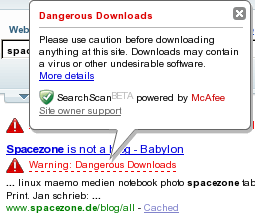
In February 2008 it seems SiteAdvisor discovered an <a href="http://www.siteadvisor.com/sites/spacezone.de/downloads/12579099/" title="SiteAdvisor Download Information">unsafe download on spacezone.de</a>. The download was part of a another website mirrored on spacezone.de and I have no idea what it is. According to McAfee it's AdWare classified as red. The mirror has been removed, the "dangerous" download is gone, but the whole domain <a href="http://www.siteadvisor.com/sites/spacezone.de" title="Web Safety Rating for spacezone.de">spacezone.de</a> is still red. (I did contact them via the feedback form. No answer yet.)
</p>
<p style="text-align:center;"><img src="http://spacezone.de/blog/images/yahoosearch.png" style="border:0px solid" title="Yahoo SERP with Security Warning" alt="Yahoo SERP with Security Warning" class="pivot-image" /></p>
<p>
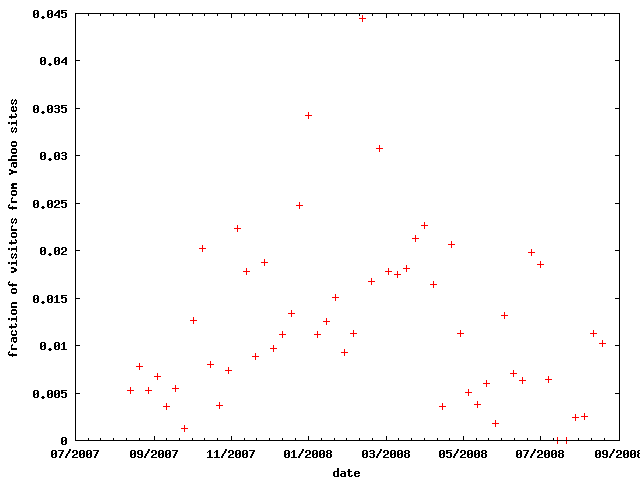
I thought, <a href="http://www.yahoo.com">Yahoo</a> users would ignore my blog as long as the <a href="http://search.yahoo.com/search?p=spacezone%20antiblog">security warning is in the SERPS</a>. However, I couldn't resist looking at the server's referrer log to see if there are any visible effects of Yahoo's warnings. So I computed to the fraction of readers coming from Yahoo sites (*.yahoo.*) to those from any other site (without internal links and direct requests).
</p>
<p style="text-align:center;"><img src="http://spacezone.de/blog/images/yahoofrac.png" style="border:0px solid" title="Fraction of Links from Yahoo" alt="Fraction of Links from Yahoo" class="pivot-image" /></p>
<p>To me this looks like a null result. It's seems Yahoo is (and has always been) irrelevant for my blog.
</p><p>
Nevertheless, siteadvisor is fun (and potentially useful if you are prone to fall for internet scam). <a href="http://www.siteadvisor.com/sites/yahoo.com" title="SiteAdvisor rating for yahoo.com">Yahoo</a>, for example, has a record of distributing AdWare, too. How comes they manage to keep their "green" status?</p>
<p><b>Update</b> SiteAdvisor "engineers" have contacted me and removed the red flag from this site.</p>
		]]></content>
		<author>
			<name>jan</name>
		</author>
	</entry>


	<entry>
		<title>CHDK: Get that Linux Feeling for your Digital Camera</title>
		<link rel="alternate" type="text/html" href="http://www.spacezone.de/blog/pivot/entry.php?id=69&amp;w=en" />
		<updated>2008-05-18T20:48:00+01:00</updated>
		<published>2008-05-18T03:04:00+01:00</published>
		<id>tag:spacezoneisnotablog,2010:Spacezoneisnotablogen.69</id>
		<link rel="related" type="text/html" href=""  />
		<summary type="text"></summary>
        <content type="html" xml:lang="en" xml:base="http://www.spacezone.de/blog/pivot/entry.php?id=69&amp;w=en"><![CDATA[
                <img src="http://spacezone.de/blog/images/rheinfall_h80px.jpg" style="border:0px solid" title="Rheinfall" alt="Rheinfall" class="pivot-image" />
<a href="http://chdk.wikia.com/wiki/Image:Drop_a.jpg" title="sourve"><img src="http://spacezone.de/blog/images/drop.jpg" style="border:0px solid" title="Drop" alt="Drop" class="pivot-image" /></a><p>
Do you remeber the first time you used Linux? The trouble of getting it to work and all the benefits you got out of it. Now you can do the same trick with your camera if it's a Canon Powershot or Ixus. Any consumer electronics device is basicly a computer (hardware and software) and <a href="http://chdk.wikia.com/wiki/Main_Page" title="CHDK Wiki">CHDK</a> is the open source software which helps you to get out most of your camera. I happen to own a supported model and before I learned about CHDK I was reluctant to recommend it, now I believe it's probably the best compact camera in the market. And most models aren't expensive.
</p><p>
There seem to be two major <a href="http://chdk.wikia.com/wiki/Firmware_Comparisons">versions of CHDK</a> at the moment, the original one by GrAnd and the advanced one by Albest as well as several niche players. Installing CHDK is as simple as copying a few files to your SD card and have the camera load it into RAM. The original firmware is not modified and <a href="http://chdk.wikia.com/wiki/FAQ#Q._Does_using_the_CHDK_program_void_your_warranty.3F">using CHDK doesn't void your warranty</a>. However, read the <a href="http://chdk.wikia.com/wiki/CHDK_in_Brief#CHDK:_How_do_I_get_started.3F">instructions</a>, even if you don't follow them!
</p><p>
When <a href="http://chdk.wikia.com/wiki/CHDK_firmware_usage">using CHDK</a> all features of your camera continue to work as before. There will however be an ALTernative menu on a rarely used button, usually "direct print". which lets you override your camera's settings beyond all exspectations:
</p>
<ul><li>Addition information on screen while shooting:</li>
<ul><li><a href="http://www.luminous-landscape.com/tutorials/understanding-series/understanding-histograms.shtml">Histograms</a> and <a href="http://thedvshow.com/faq-pro/?action=article&cat_id=002&id=2&lang=">"Zebras"</a> to help avoiding overexposures. It's a simple feature, but you don't want to miss it.</li>
<li>Distance to Subject and <a href="http://en.wikipedia.org/wiki/Depth_of_field">Depth of Field</a>: Ever wondered how professional photos have sharp details and blurry backgrounds? That's how.</li>
</ul>
<li>Additional shooting modes:</li>
<ul><li>Set Aperture Size, Shutter Time and ISO sensitivity to extrem values allowing for <a href="http://chdk.wikia.com/wiki/Samples:_High-Speed_Shutter_%26_Flash-Sync">High Speed Photography</a>.</li>
<li>Shot (and process) RAW images, a feature usually found in more expensive cameras</a>.</li>
<li>Record series of images like <a href="http://zonebattler.twoday.net/stories/1769704/#3738072">exposures brackets</a> for HDR.</li>
<li>Automagically take difficult shoots such as <a href="http://chdk.wikia.com/wiki/Samples:_Lightning_photography">Lightning</a>.</li>
</ul>
<li>Customize your camera's software:</li>
<ul>
<li>SCRIPTS! Start hacking yourself.</li>
<li>Remote control and trigger.</li>
<li>Custom menus, grids, shooting modes.</li>
</ul>
</ul>
<p>
Did you believe, cheap cameras could be that powerful? Well, the hardware always was,
<a href="http://www.fsf.org/blogs/community/antifeatures" title="Antifeatures">the software they ship is cheap</a>.
</p>
<a href="http://spacezone.de/blog/images/rheinfall_w1024px.jpg"><p style="text-align:center;"><img src="http://spacezone.de/blog/images/rheinfall_w300px.jpg" style="border:0px solid" title="" alt="" class="pivot-image" /></p></a>
<p>The picture above taken with my A540 and CHDK Albest shows the <a href="http://www.about.ch/cantons/schaffhausen/rheinfall/index.html" title="Rheinfall">Rhine Falls</a> at dusk.
The drop is a work by <a href="http://chdk.wikia.com/wiki/Image:Drop_a.jpg">Keoeeit</a>.</p>
		]]></content>
		<author>
			<name>jan</name>
		</author>
	</entry>


	<entry>
		<title>Free your browser's address bar</title>
		<link rel="alternate" type="text/html" href="http://www.spacezone.de/blog/pivot/entry.php?id=65&amp;w=en" />
		<updated>2008-04-05T01:26:00+01:00</updated>
		<published>2008-04-01T23:34:00+01:00</published>
		<id>tag:spacezoneisnotablog,2010:Spacezoneisnotablogen.65</id>
		<link rel="related" type="text/html" href=""  />
		<summary type="text"></summary>
        <content type="html" xml:lang="en" xml:base="http://www.spacezone.de/blog/pivot/entry.php?id=65&amp;w=en"><![CDATA[
                <p>
Problem 1:
<b>User Laziness:</b>
Surfing the web usually starts with using a text entry field, often called address bar. However, while it's possible to enter a full <a href="http://en.wikipedia.org/wiki/Uniform_Resource_Identifier" title="http://en.wikipedia.org/wiki/Uniform Resource Identifier">URI</a> here, most people use a single word. Depending on browser and configuration this takes them either to http://keyword/ or http://www.keyword.com or (the most likely case nowadays) a search engine performing a search on "keyword". This may seem natural and convient but when people google for "google" to find google.com, there's something wrong. However it's not a bug, which we can expect to be fixed any time soon, because search engines, browser and device makers have built a business model around this "wrong".
</p><p>
Problem 2:
<b>Search Engine Monopolization and Forced Localization:</b>
If all your searches happen via Google you'll only know about the part of the web Google wants you to see. Many search engines try to detect the user's language and location and deliever localized results (and ads) even if the user explicitly selects "include all languages" or navigates to the English/global/.com homepage. However editing the query URI does the trick (for google edit "?hl=") .
</p><p>
Solution to problem 2:
<b>Customizable Search Form that gives you choice:</b>
<a href="http://www.spacezone.de/blog/static/search.html" title="search.html">A simple web form</a> with a text entry field and many buttons provides all your favourite search engines and other websites like Wikipedia or social bookmarking services. Customizing is simple, all it takes is a HTML button which calls the Javascript function go(uriString):
<code>
&lt;input type="button" value="TITLE"  /&gt;
</code>
The query will be appended to uriString.
</p><p>
Solution to problem 1:
<b>Overwrite your browser's default search engine:</b>
For Gecko based browsers such as Firefox, Iceweasel, Galeon, Epiphany (all tested on Debian Etch) or microB (part of <a href="http://www.spacezone.de/blog/pivot/entry.php?id=58&amp;w=en">Internet Tablet</a> OS2008), you can go to <code>about:config</code> and set <code>keyword.URL</code> to <code>file:///path/to/search.html?s=</code> where search.html is your customized version of <a href="http://www.spacezone.de/blog/static/search.html" title="search.html">search.html</a>,
<code>keyword.enabled</code> to <code>true</code>. For Konqueror you need to set up a search engine for search.html and make it default. (Use a local copy, I don't want to track your searches.)
</p><p>
Free extra:
<b>Guessing URIs:</b>
Should the query you entered be a domain name, a URI or a part thereof, search.html will offer a list of guessed links. My versions uses German, Austrian, Swiss and international top level domains. To customize this, overwrite the tld array. This part was difficult to implement because guessing a URI and encoding it "correctly" is stricly speaking impossible. I decided not to encode the host part to make <a href="http://en.wikipedia.org/wiki/Internationalized_domain_name" title="Internationalized Domain Names">IDNs</a> work. The URI handling business uses <a href="http://blog.stevenlevithan.com/archives/parseuri">parseUri 1.2</a>.
</p><p>
Long Story Short: Invest 30 minutes to download, set up and customize search.html and you'll have a powerful search tool inside your browser. I know that some browsers (like Firefox and Konquerer) allow sophisticated search engine integration, but this script has the additional benefit of breaking your browsing habbits.</p>
		]]></content>
		<author>
			<name>jan</name>
		</author>
	</entry>


	<entry>
		<title>Rise of Linux thanks to cheap consumer products?</title>
		<link rel="alternate" type="text/html" href="http://www.spacezone.de/blog/pivot/entry.php?id=61&amp;w=en" />
		<updated>2008-03-12T01:01:00+01:00</updated>
		<published>2008-02-11T01:28:00+01:00</published>
		<id>tag:spacezoneisnotablog,2010:Spacezoneisnotablogen.61</id>
		<link rel="related" type="text/html" href=""  />
		<summary type="text"></summary>
        <content type="html" xml:lang="en" xml:base="http://www.spacezone.de/blog/pivot/entry.php?id=61&amp;w=en"><![CDATA[
                <a href="http://flickr.com/photos/mindscape/90213623/"><img src="http://spacezone.de/blog/images/tuxkillbill_h80px.jpg" style="border:0px solid" title="Tux Kill Bill" alt="Tux Kill Bill" class="pivot-image" /></a><p>
The pattern in the 100$ laptop, Asus' <a href="http://en.wikipedia.org/wiki/ASUS_Eee_PC" title="Eee PC">eeeProducts</a> (or <a href="http://www.gadgetell.com/tech/comment/asus-announces-e-tv-e-dt-e-monitor/">E-Products</a>) and Everex's Cloudbook seems to be: Take Linux and make something cheap. However, I feel we should  include Apple's iPhone and <a href="http://www.spacezone.de/blog/pivot/entry.php?id=58&w=en" title="N810 Review">Nokia's Internet Tablet</a> and call it: Take standard hard- and software and make something exciting! <i>Cheap music players didn't kill the iPod, did they?</i> By the way, the key to low prices is mass production not free software.
</p><p>
I included the iPhone here because (I think) Apple uses the <a href="http://en.wikipedia.org/wiki/Darwin_(operating_system)">Darwin</a> kernel from the BSD family and <a href="http://en.wikipedia.org/wiki/WebKit">Webkit</a>, which is related to the KDE project.
<i>Would you consider Apple an open source vendor? Do you think the BSD and KDE communities have benefited from Apple's success?</i>
</p><p>
Counting the products mentioned above and upcoming Linux based phones (<a href="http://www.openmoko.com/">OpenMoko</a>, <a href="http://code.google.com/android/" title="Google Android">Android</a>, <a href="http://en.wikipedia.org/wiki/Qtopia">Qtopia</a>) we can expect a growing number of Tux driven gadgets on the shelves. Linux could easily become the most widely used embedded OS in the near future. One could assume the so-called alternative is harder to ignore when it comes in large numbers, <i>but don't you remember how ignorant they are?</i>
</p><p>
Like bloggers using an open source browser (Firefox) to access a free software based weblog or CMS (all of them) via an open standards protocol (HTTP) to tell you why open source will never work, how only money drives innovation and why proprietary is better. Without even knowing it those people may already have Linux on their phones, routers or <a href="http://www.tomtom.com/page.php?Page=gpl" title="TomTom">car navigation systems</a>. <i>What difference can another penguin make?</i>
</p><p>
Same story on the vendor side of the game: They offer one Linux product (or a few), which happens to be successful. They opened some specifications, drivers and interfaces because it made this particular product possible (or better). We cannot assume they suddenly changed their minds. Most of their business is still tailored around locked down proprietary systems. <i>Would Asus help me installing Linux on their regular notebooks?</i>
</p><p>
I'm as excited as everyone else is about the availability of consumer ready Linux devices. Finally, Tux in everyone's homes and pockets! It's possible now. But it has been possible (technically) for at least <a href="http://lwn.net/2001/features/Timeline/?month=all" title="State of Linux in 2001">seven years now</a>. This is all great, but it's not exactly a revolution.
</p><p>
<tt>[The Tux Kill Bill photo has been released under a CC-BY-NC license by <a href="http://flickr.com/photos/mindscape/90213623/">sonicbloom</a>.]</tt></p>
		]]></content>
		<author>
			<name>jan</name>
		</author>
	</entry>


	<entry>
		<title>Darts</title>
		<link rel="alternate" type="text/html" href="http://www.spacezone.de/blog/pivot/entry.php?id=60&amp;w=en" />
		<updated>2008-02-05T17:04:00+01:00</updated>
		<published>2008-02-05T17:04:00+01:00</published>
		<id>tag:spacezoneisnotablog,2010:Spacezoneisnotablogen.60</id>
		<link rel="related" type="text/html" href=""  />
		<summary type="text"></summary>
        <content type="html" xml:lang="en" xml:base="http://www.spacezone.de/blog/pivot/entry.php?id=60&amp;w=en"><![CDATA[
                <img src="http://spacezone.de/blog/images/dart1_h80px.jpg" style="border:0px solid" title="Darts" alt="Darts" class="pivot-image" />
<img src="http://spacezone.de/blog/images/dart4_h80px.jpg" style="border:0px solid" title="Darts" alt="Darts" class="pivot-image" /><p>At the moment I can access the internet only via GPRS or by taking the bus to the university. What can I blog? Photos!</p>
<p><a href="http://spacezone.de/blog/images/dart1_w1024px.jpg"><img src="http://spacezone.de/blog/images/dart1_w400px.jpg" style="border:0px solid" title="" alt="" class="pivot-image" /></a></p>
<p><a href="http://spacezone.de/blog/images/dart4_w1024px.jpg"><img src="http://spacezone.de/blog/images/dart4_w400px.jpg" style="border:0px solid" title="" alt="" class="pivot-image" /></a></p>
		]]></content>
		<author>
			<name>jan</name>
		</author>
	</entry>


	<entry>
		<title>Nokia N810 Linux Handheld aka Internet Tablet</title>
		<link rel="alternate" type="text/html" href="http://www.spacezone.de/blog/pivot/entry.php?id=58&amp;w=en" />
		<updated>2008-01-05T02:00:00+01:00</updated>
		<published>2008-01-05T00:58:00+01:00</published>
		<id>tag:spacezoneisnotablog,2010:Spacezoneisnotablogen.58</id>
		<link rel="related" type="text/html" href=""  />
		<summary type="text"></summary>
        <content type="html" xml:lang="en" xml:base="http://www.spacezone.de/blog/pivot/entry.php?id=58&amp;w=en"><![CDATA[
                <a href="http://spacezone.de/blog/images/n810_wkb_w800px.jpg"><img src="http://spacezone.de/blog/images/n810_wkb_h80px.jpg" style="border:0px solid" title="N810 slide keyboard" alt="N810 slide keyboard" class="pivot-image" /></a>
<a href="http://spacezone.de/blog/images/n810_zaurus_h768px.jpg"><img src="http://spacezone.de/blog/images/n810_zaurus_h80px.jpg" style="border:0px solid" title="N810" alt="N810" class="pivot-image" /></a><p>
<b>Linux based</b> products are usually criticised for not being Windows. Because Linux is an OS. When Nokia introduced the first Internet Tablet reviewers complained it wasn't a phone. Because Nokia is a phone company. And when elder people who grew up without ubiquitous internet access learn about these tablets they tend to miss the lack of PIM applications. Because a decade ago PDAs were used exclusively to store dates and contacts.
</p><p>
Most consumer products are sold with a single <b>killer application</b> in mind and some extra features thrown in. Here the killer application is web browsing, the extras are audio and video playback and streaming, messaging and VoIP. Combining a 800px screen and a <a href="http://www.linuxdevices.com/news/NS8360022837.html" title="maemo microB">Mozilla based browser</a> (like a portable version of Firefox) which plays nice with Javascript and Flash <a href="http://www.brighthand.com/default.asp?newsID=13497" title="Review of the N810">OS2008 tablets really excel at Desktop like web browsing</a>.
</p><p>
Whether we like it or, web surfing, communication and media are typical uses of computers nowadays. Many people do nothing else with there heavy and expensive notebooks. Consequently Internet Tablets have been compared to <a href="http://www.popularmechanics.com/technology/reviews/4242980.html?page=2">$2000 UMPCs</a> and <a href="http://linux.wordpress.com/2007/12/02/asus-eee-701-vs-nokia-n810-linux-fight/">Asus' eeePC</a>.
</p><p>
For me, the N810 will replace my Zaurus SL-C860. Look how similar they are:<br />
<img src="http://spacezone.de/blog/images/n810_side_w300px.jpg" style="border:0px solid" title="N810 and Zaurus from the side" alt="N810 and Zaurus from the side" class="pivot-image" />
<br />
<a href="http://spacezone.de/blog/images/n810_zaurus_h768px.jpg"><img src="http://spacezone.de/blog/images/n810_zaurus_w300px.jpg" style="border:0px solid" title="N810 and Zaurus from the top" alt="N810 and Zaurus from the top" class="pivot-image" /></a>
<br />
While the Zaurus used to be slightly more flexible with CF cards and custom ROMs, it never came close to N810's out of the box experience.
</p>
<p>The N810 is a <b>N800 plus keyboard plus GPS</b> running the latest software version called OS2008. Most people are disappointed with both the cellphone like thumb keyboard and the built-in GPS compared to external (Bluetooth or USB) variants. I'm impressed how they can squeeze so many things into such a small device, so I'm not going to complain.
</p>
<p>
<b>What's in it for the open source community?</b>
Seeing Nokia's <a href="http://www.boingboing.net/2007/12/09/nokia-to-w3c-ogg-is.html">anti OGG, pro DRM</a>, <a href="http://eupat.ffii.org/akteure/nokia/index.en.html">pro software patent</a> policies and the fact the some Internet Tablet related software is closed source, we cannot consider Nokia a hacker friendly company at the moment. However, unlike locked down (i)Phones, using <a href="http://www.maemo.org">Maemo</a> we can develop and use Open Source Software easily. And there's <a href="http://xkcd.com/353/" title="Comic: Python">Python</a> for Maemo.
</p>
<p>
<b>Curious?</b> Best place to learn about these devices is <a href="http://www.internettablettalk.com" title="Internet Tablet Talk">Internet Tablet Talk</a>.</p>
		]]></content>
		<author>
			<name>jan</name>
		</author>
	</entry>


	<entry>
		<title>Are you worried about Microsoft dominating the Desktop OS market? I'm  not.</title>
		<link rel="alternate" type="text/html" href="http://www.spacezone.de/blog/pivot/entry.php?id=51&amp;w=en" />
		<updated>2007-10-26T21:48:00+01:00</updated>
		<published>2007-10-26T21:41:00+01:00</published>
		<id>tag:spacezoneisnotablog,2010:Spacezoneisnotablogen.51</id>
		<link rel="related" type="text/html" href=""  />
		<summary type="text"></summary>
        <content type="html" xml:lang="en" xml:base="http://www.spacezone.de/blog/pivot/entry.php?id=51&amp;w=en"><![CDATA[
                <p>
I used to think of Microsoft as the evil empire. That started back when I was still a paying Windows customer. As  a Linux user (and advocate) I'm supposed to dislike Microsoft even more. Before fighting Linux, they ignored us. Now it's time we ignore them. And it's pretty simple.
</p><p>
They say <b>90% of all Desktop computers</b> run Windows but those are not my computers. I used to tell people Windows was bad. I was lying because I have never used any current version of Windows and never will, not XP and not Vista. It's just another product that I'm not even considering to buy. Like chewing gum flavoured spring water. It's ridiculous and disgusting (to me). And it's a reality in the market but it's not exacty a problem, not  as long as they still make other drinks.
</p><p>
Windows Desktop users (fanboys and regular <a href="http://www.unitedmedia.com/comics/dilbert/dnrc/html/report_an_induhvidual.html" title="Dilbert">Induhviduals</a>) can be annoying, but Windows/Mac fanboys forced to use Linux are worse. (I don't know anyone who runs Windows Server, but I believe we can safely assume they aren't any different.) While I feel sorry for those who believe Windows is the only OS, I don't think we can blame <a href="http://en.wikipedia.org/wiki/Steve_Ballmer" title="Steve Ballmer">Ballmer</a> for that. He talks regularly about Linux. The intended message may be anti-Linux <a href="http://en.wikipedia.org/wiki/Fear,_uncertainty_and_doubt" title="Fear, Uncertainty, Doubt">FUD</a>, but for most people (i.e. that 90%) it's much simpler: <b>"Linux exists!"</b>
</p><p>
The <b>notebook market</b> is different, because notebooks are almost always sold as packages of hard- and software. You can install a different operating system and usually get some refund for the bundled copy of Windows, but you won't know how well this works unless you try or trust someone else who tried before. Some notebook vendors have supported Linux long before Dell did and others were well known to play nice with the free operating system but those were usually the more expensive ones and only few people knew about them at all. That's why <a href="http://www.dell.com/content/topics/segtopic.aspx/ubuntu?c=us&amp;cs=19&amp;l=en&amp;s=dhs">Dell's Ubuntu notebooks</a>, the <a href="http://eeepc.asus.com/en/" title="Asus Eee PC">Asus</a> <a href="http://www.eeeuser.com/" title="eeeUser">eeePC</a> and the <a href="http://laptop.org/laptop/" title="One Laptop Per Child">One Linux Per Geek</a> project are so damn interesting: Affordable and marketed for a large audience. And then there's <a href="http://www.apple.com/getamac/ads/" title="Get a Mac">Apple</a>. Not really a monopoly here either.
</p><p>
We should be worried about the <b>media industry</b> instead. Anything you hate about software, you'll find it there: Monopolies, <a href="http://drm.info/en" title="DRM">Digital Restrictions Management</a>, <a href="http://www.fsf.org/blogs/community/antifeatures">anti-features</a>, patents, <a href="http://xkcd.com/129/" title="xkcd comic: HDMI">corporate control about customers</a>. Anything you like about computers is lacking: You can't do what you want with a device or your data. You do what they want you to do and then you'll throw it away.
</p><p>
Did you buy a media player (portable music player, DVD player, ...) lately? Unless it is an <a href="http://www.aboyandhiscomputer.com/show.php?ItemID=2204">iProduct</a>, there is probably some Microsoft inside: A logo, a CODEC, some DRM. Today most people ignore these "features" but in few years we will complain about a new monopoly.</p>
		]]></content>
		<author>
			<name>jan</name>
		</author>
	</entry>


</feed>